
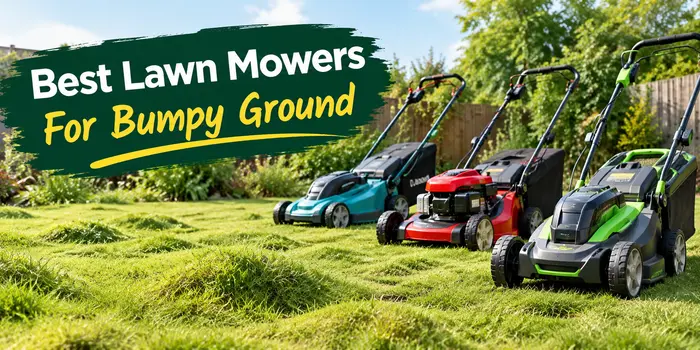
Best Lawn Mower For Bumpy Ground 2026
Last Updated on October 20, 2026
Choosing the Best Lawn Mowers For Bumpy Ground can make a big difference when your garden is full of dips, lumps and rough patches. Some mowers struggle to move smoothly across uneven grass, making the job harder than it needs to be.
To save you time and effort, we’ve compared four models based on how well they cut, how easy they are to push and how comfortably they handle rough lawns. Whether you’re tidying up a small back garden or tackling a larger patch of grass, this guide will help you find the right mower for your needs and budget.
Our Top Picks


Hyundai 46cm Self‑Propelled Petrol Mower
We found this self‑propelled petrol mower excellent on bumpy, overgrown turf thanks to large rear wheels and a robust steel deck. It copes with thicker growth and uneven surfaces while offering multiple discharge and mulching options.
Purpose and overall character
This Hyundai is built to be a workhorse for medium to large gardens where the turf is not always perfectly flat. We see it as a robust, no‑nonsense petrol option that handles undulating, bumpy ground better than most lighter electric machines because of its weight, torque and self‑propelled rear‑wheel drive.
Key features and benefits
The combination of an enclosed drive belt, large self‑drive wheels and a hard‑wearing steel deck translates to confidence on rough lawns. The seven cutting heights (25–75 mm) from a single adjustment lever let us adapt to different seasonal conditions quickly. Four discharge options — collect, rear, side and mulch — give versatility depending on grass length and how we want to finish the lawn.
Limitations and practical advice
It’s a heavier machine (around 34 kg), so turning in very tight beds or carrying steps is less convenient. There is the usual petrol maintenance overhead (fuel, oil, spark plug, winter storage), and it needs a little more user care than electrics. For gardeners with bumpy, overgrown lawns who need power and durability, this Hyundai is a well‑priced, long‑term choice. For small, flat lawns we’d suggest a lighter electric or cordless alternative to save effort and running cost.
WORX 40V Brushless 37cm Cordless Mower
We found the brushless motor and IntelliCut system deliver reassuring torque on thicker patches while conserving battery on lighter grass. The lightweight, compact deck and PowerShare battery compatibility make it versatile for bumpy, sloped gardens where cables and petrol are inconvenient.
Purpose and performance summary
We see this WORX as the best cordless compromise between agility and power for uneven gardens. The brushless NITRO motor with IntelliCut automatically increases torque when the grass thickens and scales back to conserve battery, which helps maintain a consistent cut across bumpy patches without the noise or fumes of petrol.
Features that matter on bumpy ground
The mower’s low weight (about 15.3 kg) and compact footprint mean we can lift and reposition it easily around terraces and banks, yet the electronic torque management prevents bogging down on denser growth. The 2‑in‑1 bag and mulching function give us options depending on whether we prioritise speed or lawn health.
Limitations and real-world advice
For very large or especially rough gardens you’ll need spare batteries or a petrol machine to avoid interruptions. The plastic deck keeps weight down but is less impact‑resistant than steel; avoid hammering it over hidden stones. Overall, for homeowners who want cordless convenience, adaptable power and good handling on bumpy lawns, this is one of the most balanced options we tested.
Flymo EasiGlide 36cm Hover Mower
We found this hover mower exceptionally easy to push across uneven turf and up gentle inclines thanks to its air-cushion design. It excels where wheels catch or bounce, giving a smooth, controllable cut on bumpy ground.
Purpose and what it does well
We rate this hover mower as a practical solution for small-to-medium gardens with uneven surfaces or lots of contours. Because it floats on a cushion of air the machine glides over bumps that would make wheel‑based mowers judder, which reduces scalping and gives a neater overall finish on lumpy lawns.
Key features and benefits
The EasiGlide’s strengths are simplicity and agility. The metal blade gives a clean cut, the 26 L collection box compacts clippings and the vision window helps us know when to empty without stopping. The 10 m cable is generous for most suburban gardens, and folding handles make storage straightforward.
Limitations and practical insights
It’s not the fastest choice for large lawns — the 36 cm width and corded power mean more passes and planning around the cable. It also struggles more than heavier wheeled machines when grass is very long or saturated. For many gardens with shallow hollows and slopes beneath 15°, it’s a pragmatic, low-effort option.
If you have a small, undulating garden and want minimal fuss, we’d recommend this for the way it handles bumps and awkward shapes. If your lawn is extensive or very rough and overgrown, a heavier wheeled petrol or high‑torque battery mower will be more efficient.
VonHaus 1800W Corded 43cm Mower
We found this electric mower to be an economical pick for modest lawns with occasional bumps, offering decent power and a large 52 L collection bag. It’s best where the ground is only mildly uneven and the user accepts some compromises on durability and flotation.
Where it fits and what to expect
We view this VonHaus as a sensible budget electric mower for small to medium lawns that have occasional bumps rather than severe undulations. Its 1800 W motor gives good cutting performance for the price, and the 430 mm width and 52 L bag keep sessions reasonably quick.
Key strengths and trade-offs
The large collection bag and mulching attachment are practical features that add value. For slightly uneven lawns the unit will do a tidy job, but the plastic deck and overall lighter weight mean it can skip or bounce over sharper bumps and divots, leading to an uneven finish in places.
Limitations and practical tips
We recommend using this mower on drier days and cutting regularly rather than tackling very long, wet or rock‑strewn grass. Keep the cable management in mind around slopes and beds—an extension lead rated for outdoor use and a plan for routing will reduce trips and snags. For gardeners on a tight budget with light‑to‑moderate unevenness, it’s a competent and economical option.
Final Thoughts
For truly rough, uneven lawns we recommend the Hyundai 46cm Self-Propelled Petrol Mower as our top choice. It’s the most capable for rough, uneven lawns thanks to large rear wheels, a robust steel deck and enough grunt to handle thicker growth. Choose the Hyundai when you have larger plots, persistent bumps, frequent overgrowth or tree roots — it simply keeps moving where others stall.
If you want cordless convenience without sacrificing capability, go for the WORX 40V Brushless 37cm Cordless Mower. Its brushless motor and IntelliCut system give reassuring torque on thicker patches while conserving battery on lighter areas. The WORX is our pick for medium-sized, varied terrain and sloped gardens where cables and petrol are awkward.
If neither is suitable, consider the Flymo EasiGlide 36cm Hover Mower for tight slopes and manoeuvrability, or the VonHaus 1800W Corded 43cm Mower as a budget option for mild unevenness — but treat these as niche or secondary choices rather than primary solutions for very rough turf.
Guide: How to choose and use a mower on bumpy ground
When we evaluate mowers for lumpy lawns we look beyond horsepower. Durability and terrain behaviour matter most. Here are the key aspects to compare before you buy:
What to prioritise
Tips & Tricks for mowing safely and neatly
Maintenance and care for bumpy conditions
Budget vs premium choices
Common mistakes to avoid
In short, match mower features to the chief challenge in your garden: large wheels and a steel deck for heavy, rough lawns; brushless cordless torque for varied, medium-sized plots; and hover or narrow decks for steep or highly convoluted areas. Weigh the trade-offs, maintain the machine, and you’ll turn a bumpy lawn into a manageable one without wasting time or money.
FAQ
Yes — in many cases. Hover mowers like the Flymo EasiGlide float on a cushion of air, so they don’t catch on small bumps or ruts the way wheels do. They’re excellent for slopes and tight manoeuvres, but they can struggle in very long, wet or heavily overgrown turf where flotation and traction are both needed.
Not always. Petrol mowers (like the Hyundai 46cm) generally offer more raw power and heavier decks that handle thick grass and knocks better, which helps on very rough turf. Modern cordless models such as the WORX 40V, however, now deliver strong torque, lighter handling and less fuss — making them ideal for medium-sized, bumpy gardens or where noise and fumes are a concern.
Absolutely. Larger rear wheels roll over hollows, bumps and roots far more easily than small wheels. If your lawn has persistent lumps, prioritise bigger wheels and a sturdy rear-wheel drive or self-propelled system to reduce jarring and scalping.
Keep cutting height higher on uneven lawns — don't try to mow very short in one pass. Use a mower with easy, central height adjustment so you can leave the deck a touch higher, and go over tricky spots at a slower pace or with a mulching setup instead of trying to remove every blade in one go.
A bit more than a mower used on pristine turf. Check and sharpen blades regularly, inspect wheels and bearings for damage, tighten deck bolts, and clear grass build-up under the deck. For petrol models, follow engine service intervals closely; for cordless models, look after the batteries and keep terminals clean.
