Last Updated on February 18, 2026
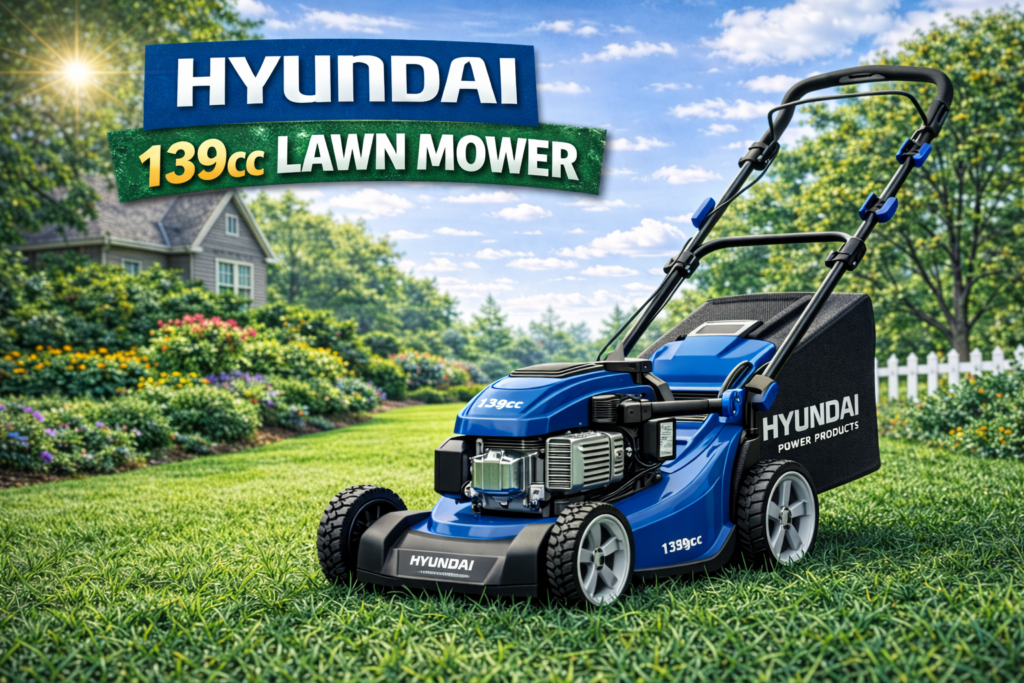
The Hyundai 139cc lawn mower is a reliable petrol powered machine designed to handle everyday lawn care with ease. Manufactured by Hyundai, this mower combines a robust 139cc engine with user friendly controls, making it ideal for small to medium-sized gardens. Its powerful performance, durable build and smooth operation help deliver clean, consistent cuts across different grass conditions.
Whether you’re upgrading your old mower or buying your first petrol model, the Hyundai 139cc lawn mower offers a practical balance of power and efficiency.
We’ll explore its key features, cutting performance, maintenance tips and why it’s a popular choice among homeowners looking for dependable lawn care equipment.
Hyundai 17" 139cc Self-Propelled Lawnmower with 45L Collector

You get a powerful, no-frills petrol mower that balances cutting performance and convenience for small-to-medium gardens. It’s best if you prioritise reliable engine power and reduced pushing effort, but be prepared for manual starting and a bit of assembly.
Overview
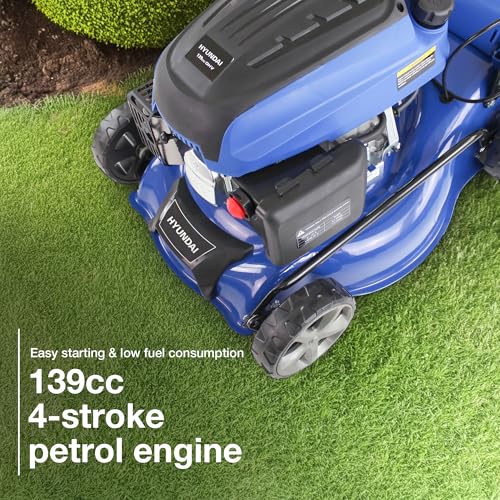
You’re looking at a compact, petrol-powered self-propelled mower designed to make routine lawn care faster on small to medium-sized gardens. Powered by a 139cc 4-stroke Hyundai engine, this 17″ (42 cm) machine delivers a combination of torque, fuel economy and low-maintenance operation that you’ll notice on first use. It pairs a responsive drive system with a 45-litre rear grass collector and foldable handles so you can store it in tighter spaces when the season’s over.
What this mower is intended for
This model is aimed at homeowners who maintain medium complexity lawns think yards with a mix of flat areas, small slopes and flowerbed edges where manoeuvrability matters. It’s not a commercial machine for daily heavy-duty jobs, but it’s more robust and flexible than many entry-level electrics.
Key features at a glance
Technical specifications (select)
| Specification | Detail |
|---|---|
| Engine | 139cc 4-stroke Hyundai |
| Cutting width | 17″ / 42 cm |
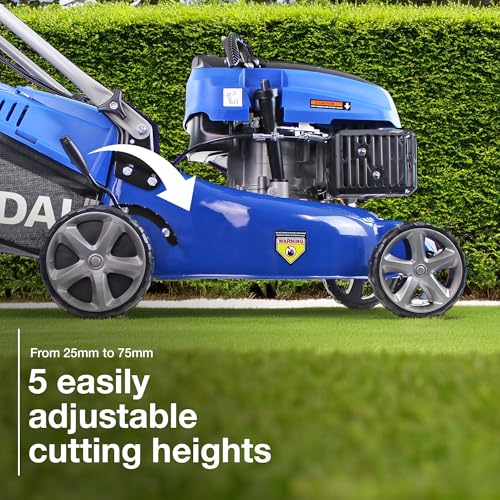
| Cutting heights | 5 positions: 25–75 mm |
| Grass collector | 45 litres |
| Weight | ~28 kg |
| Storage | Foldable handles |
Engine & drive: what you’ll experience
The 139cc 4-stroke engine is one of the mower’s strongest assets. You’ll notice a reassuringly solid pull of power when cutting thicker swards; it won’t stall easily under moderate loads and it runs on regular petrol. Because it’s a 4-stroke you don’t need to premix oil and fuel and oil consumption is typically modest.
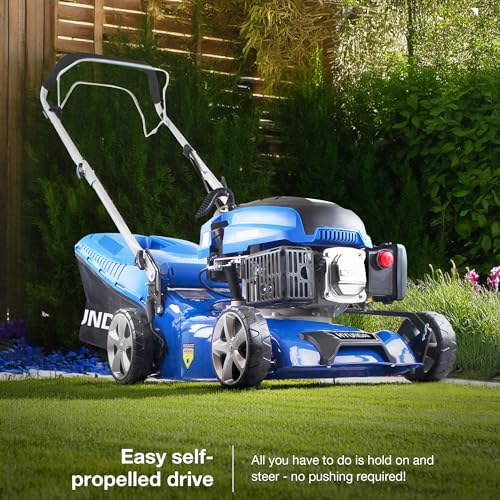
The self-propelled drive engages the rear wheels to push the mower forward. For you, that means less fatigue on longer runs or gentle slopes: the mower does a lot of the forward work. However, you still need to steer and control speed, so it isn’t a “set and forget” autopilot.
Cutting performance and grass management
Cutting width and blade design are well matched to suburban lawns. At 42 cm you’ll accomplish a decent swathe per pass while retaining the ability to turn in tighter lawn layouts.
In thicker, wet or very long grass you may experience occasional clogging or more frequent filling of the collector. You should plan mowing when grass is dry where possible for the most consistent results.
Build quality, ergonomics and storage
The chassis uses alloy steel components and is engineered to take homeowner wear-and-tear. The folding handle mechanism makes it straightforward to reduce the mower’s footprint for storage in a shed or garage. Controls are simple: a recoil pull-start, a throttle/drive engagement lever and a cutting height lever.
Ergonomically you’ll benefit from the drive system on flatter runs, but note the overall mass. At around 28 kg you’ll feel the weight when navigating around tight obstacles or lifting into a van.

Assembly, maintenance and ownership considerations
You’ll need to allow some time for initial assembly. Most users report that assembly is manageable with basic tools, but some parts can be fiddly particularly aligning the grass box and attaching cable routing. Keep the manual close for correct cable routing and bolt torque.
Routine maintenance tasks you should plan for:
Good use cases and who should choose this mower
This mower is a solid pick if you:
It’s less suitable if you:
Troubleshooting and tips for best results
FAQ
No special fuel is required — use regular unleaded petrol. The mower uses a 4-stroke engine, so oil is kept separate from fuel. Use the recommended engine oil grade in the manual (an initial oil sample is often supplied with the product). Change oil on the schedule given in the manual to maintain performance.
Sharpen the blade at least once per season for typical domestic use — more frequently if you cut abrasive or sandy turf. Replace the blade if it shows significant nicks, bends or metal fatigue. A well-maintained blade improves cut quality and reduces engine strain.
Mow when the grass is dry and raise the cutting height for the first pass if the grass is very long. Use a slower ground speed and avoid trying to mulch an excessive load in one pass. If the collector packs down, stop, switch off the engine and clear the bag carefully.
Yes, the self-propelled drive helps on gentle slopes and uneven ground, but you should exercise caution on steep inclines. Always maintain control and walk alongside the mower rather than behind it on very steep gradients. Check the manual for maximum recommended slope guidelines.
This model uses a recoil pull-start only and does not come with an electric start. If you require electric start, you’ll need to look at higher-end or different model variants that include that feature.
With the handles folded the mower becomes substantially more compact, making it suitable for most standard garden sheds or garage corners. You should allow space for easy access and basic maintenance rather than trying to squeeze it in tightly.
Run the fuel out or add a stabiliser, change the oil, clean the deck and collector, and remove the spark plug to prevent accidental starts during storage. Store the mower undercover to protect metal parts and the carburettor from condensation and corrosion.
Check the spark plug condition, ensure fresh fuel, confirm the choke position is correct, and that the oil level is within spec. Pull-start technique matters too: a steady, firm pull (not jerky) is best. If trouble persists, inspect the carburettor and fuel lines for blockages or stale fuel.
Summary
You can expect robust petrol performance from a compact, relatively easy-to-store mower that reduces pushing effort through its self-propelled system. It performs well across typical garden tasks and gives you the flexibility of multiple cutting heights and a sizeable collector. If you accept manual starting and periodic fiddly assembly, it’s a practical and cost-effective tool for most home lawns.